

Following the STED super-resolution module implemented on a Leica SP8 confocal microscope, the CPTP imaging platform is incorporating new expertise in this same field, with super-resolution fluorescence imaging in the form of «dSTORM nanoscopy». Furthermore, the IBCG platform has equipped itself with a similar nSTORM system.
Confocal microscopy is an approximate approach for localising the smallest cell organelles, intracellular specialisation domains, or even membrane proteins. The recent development of super-resolution microscopes, or nano-microscopes, makes it possible to overcome the optical diffraction barrier that limits the resolution of conventional approaches, thereby enabling the visualisation of objects on the scale of a few tens of nanometres.
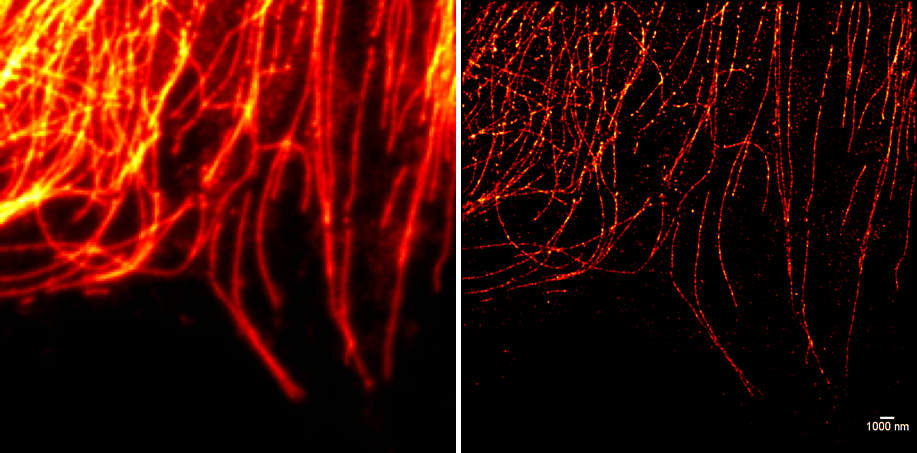
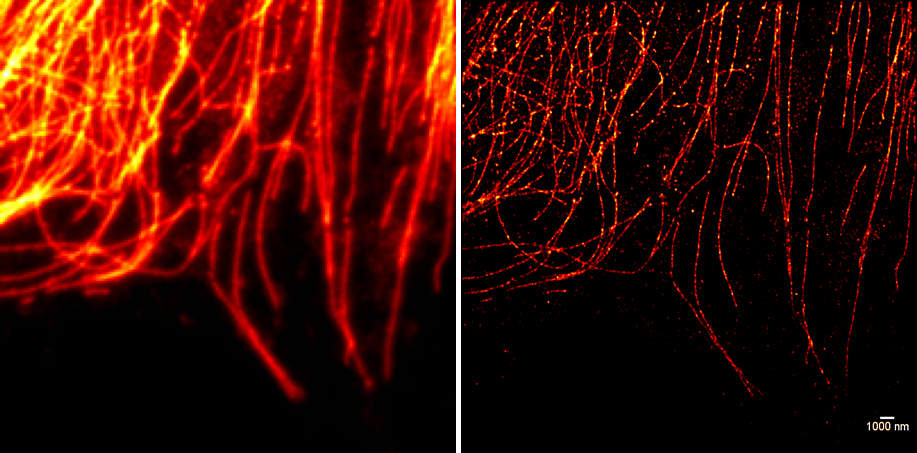
The most precise super-resolution approach (20 nm resolution) is localisation microscopy. It is based on the principle of single-molecule detection and the localisation of the centre of its diffraction spot. The accumulation of acquisitions then enables the reconstruction of a super-resolved image. PALM (PhotoActivated Localization Microscopy) and STORM (STochastic Optical Reconstruction Microscopy) are pointillism-based image reconstruction techniques that isolate single emitting molecules in different ways.
Thus, dSTORM and nSTORM open up a new field of exploration for investigating the detailed localisation of molecules governing cellular interactions at a resolution of a few tens of nanometres on fixed specimens.
The technical platforms of’cell imaging of CPTP and the IBCG have gained genuine expertise by developing STORM-type approaches in TIRF microscopy. These skills range from the development of sample preparation protocols for fixed samples (see actin filaments photo above) to the optimisation of acquisition and image reconstruction conditions for the production of 2D single-colour super-resolution images.
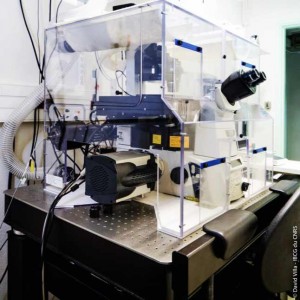
Technical specifications
d-STORM
- TIRF
- 400 mW 640 nm laser .
n-STORM
- TIRF
- Lasers: 405nm (100mW), 488nm (200mW), 561nm (200mW), 647nm (300mW)