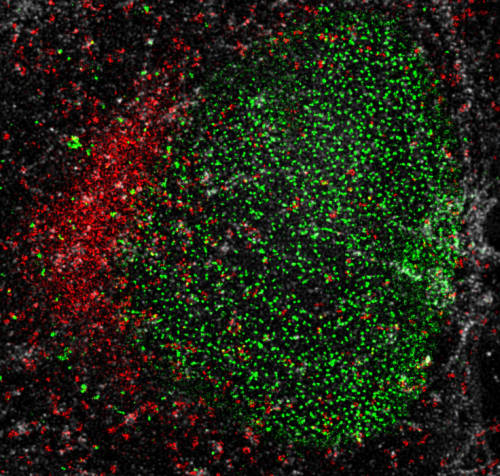

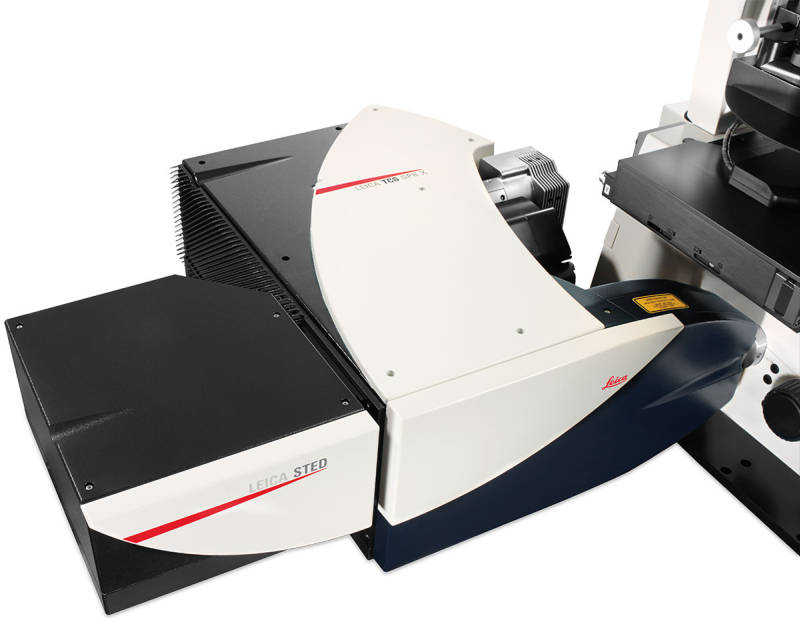
The CPTP imaging platform will shortly be receiving a «STED 3X 775nm» super-resolution module on the SP8 confocal microscope.
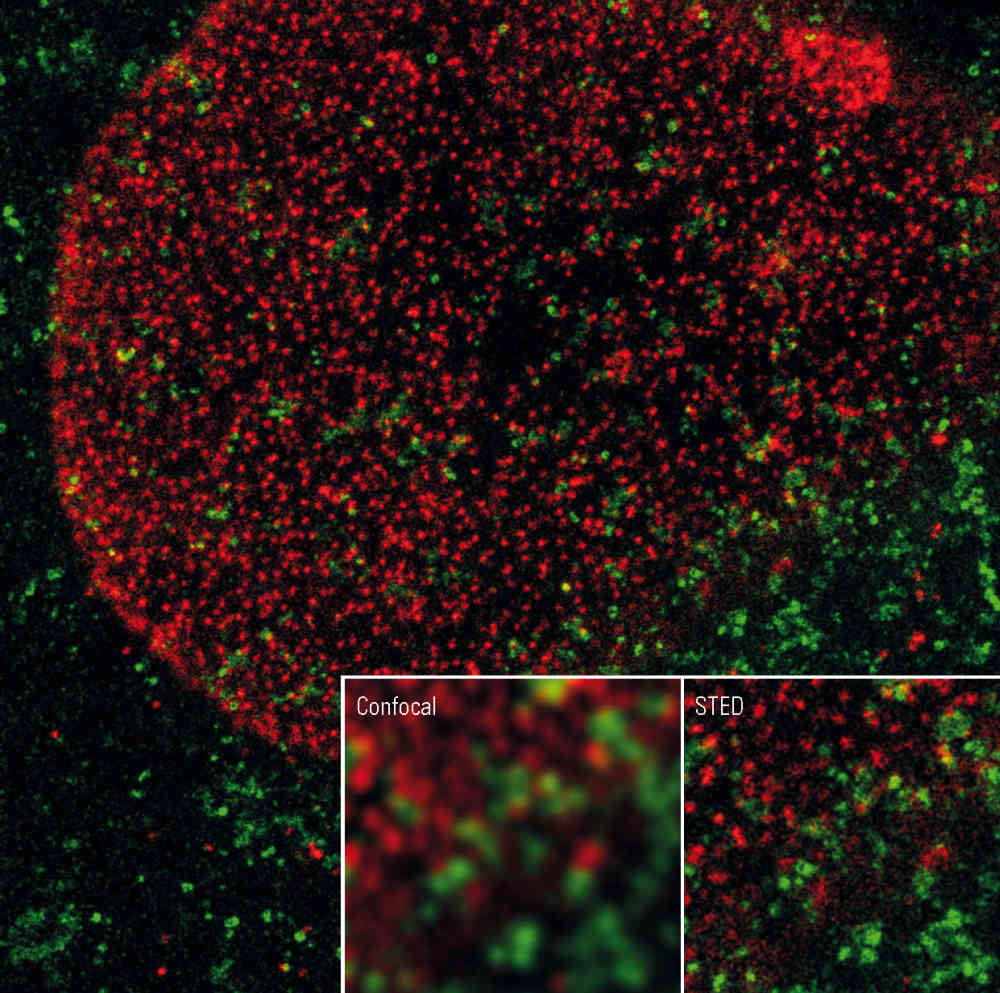
 The recent development of super-resolution imaging techniques (resolution ≤ 50 nm) compatible with live cell dynamics earned Stefan Hell, Eric Betzig and William Moerner the 2014 Nobel Prize in Chemistry. This notable improvement in resolution is extremely promising as it opens up new fields of investigation at the nanoscale scale. Super-resolution microscopy has already proven to be essential in virology, oncology and neuroscience. Access to super-resolution microscopy has become an absolute necessity to successfully conduct competitive research in many fields of biology, and notably in immunology.
More specifically, the stimulated emission depletion (STED) approach, which relies on a confocal scanning principle, is experiencing rapid developments and allows an acquisition speed of the order of a second, compared to several minutes with technologies based on pointillism (PALM/STORM). Soon, a 3D STED unit will be installed on the Leica SP8 confocal microscope, enabling two-colour imaging in the infrared with a resolution of the order of 50 nm. This equipment was funded by the Midi-Pyrénées Region using its own funds, and by the 2015 IDEX equipment scheme.
The acquisition of this equipment forms part of an overarching flagship project by the TRI-Genotoul platform (Toulouse Imaging Network, headed by Alain Jauneau and Philippe Cochard) to develop a super-resolution microscopy centre in Toulouse using various complementary approaches. The STED will enable the wider Toulouse scientific community to overcome a major technological hurdle. The unique feature of STED is that it is the only super-resolution microscope capable of working on tissue sections, which opens up the extremely exciting prospect of gaining access to human physiopathology. It is particularly popular with teams in Toulouse working in the fields of innate immunity, lymphocyte interactions, dermatology, cancer and host/pathogen interactions.