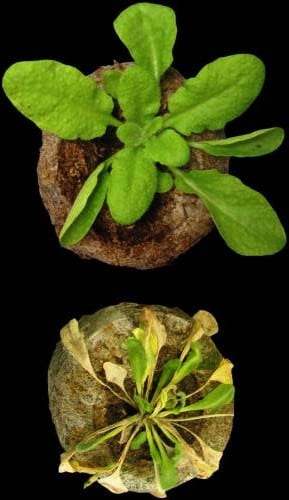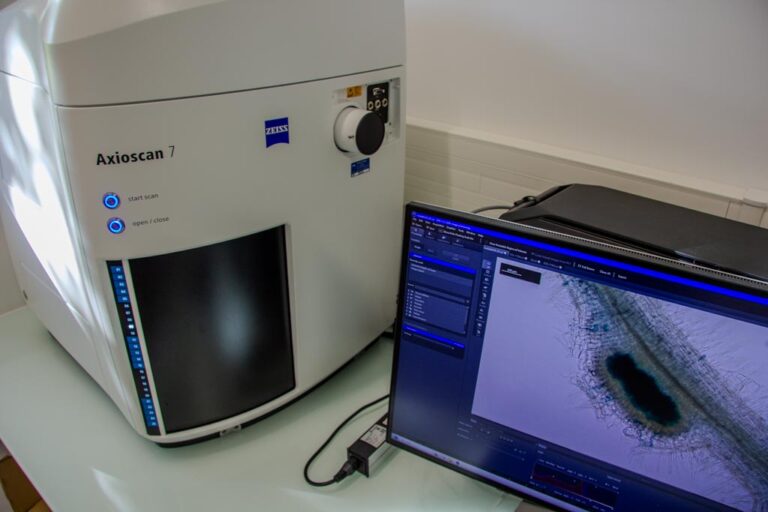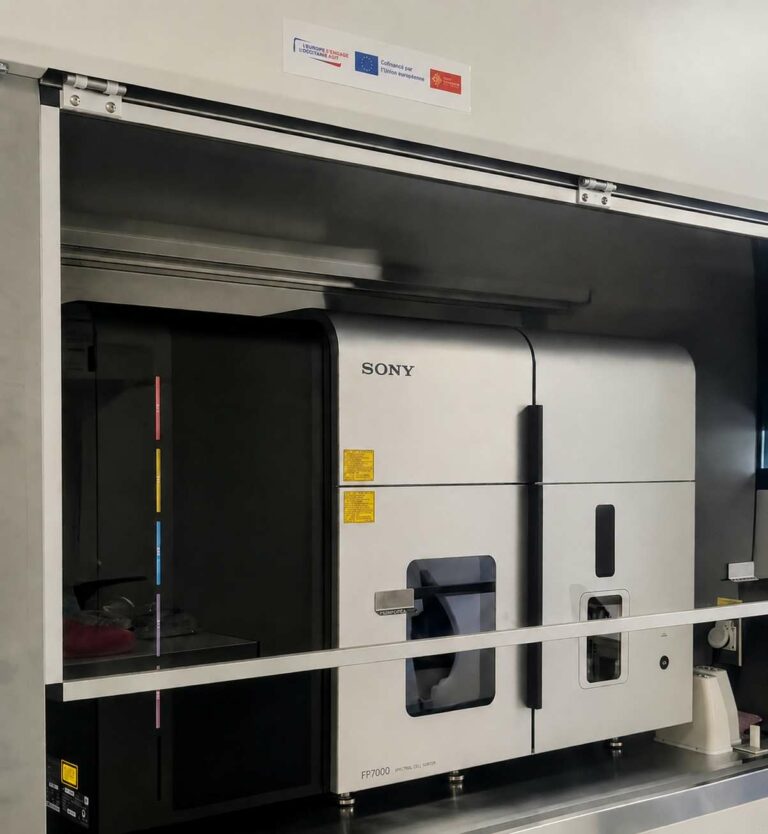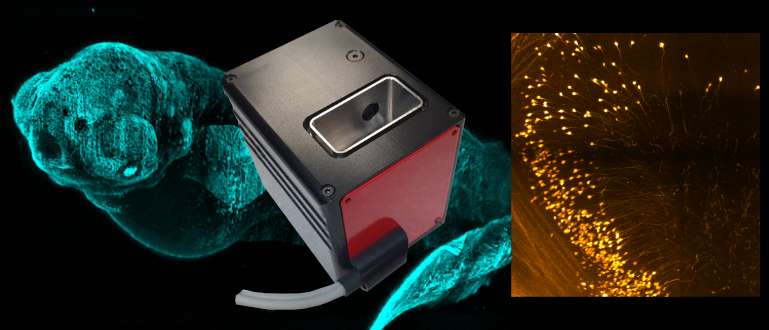

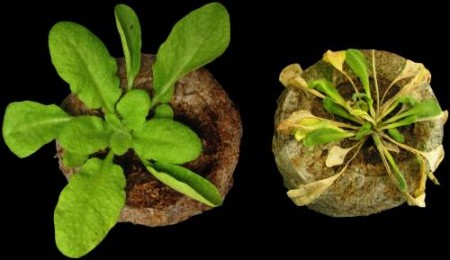
Ideas form the engine of research. But, without the technique enabling them to be supported, they would remain merely pious wishes. In the breakthrough published this 21 May in the prestigious journal Cell and highlighting the molecular tricks of a model plant, Arabidopsis, to escape one of its main attackers, the imaging provided by the TRI-Genotoul network played a major role. Aside from confocal microscopy, it is a technique developed on site, the streak-FLIM system (Hamamatsu), which, enabling the highlighting in situ of interactions between molecules, has played an essential role. A risky venture nevertheless, which began nearly 8 years ago with the acquisition of ultra-high-tech equipment, skills and associated know-how.
 « Among the technologies available on the market, the one offered by Hamamatsu seemed particularly innovative and promising to us. The risks of failure were far from negligible: the only machine of this type in operation was in Texas and we had very little feedback... »Explain Alain Jauneau behind the installation of the streak-film at Toulouse.« Following on-site testing, we opted for this one and implemented a complete optical bench. The installation and implementation were complex and required a wide range of skills. »Hamamatsu company engineers for the technical aspects on the one hand, and the skills and know-how of members of a CNRS national network, the RTmfm (Multi-Functional Fluorescence Microscopy Technological Network) during the validation phases, on the other. Locally, mathematics and data processing researchers from the LRSV and the IRIT were involved, alongside biologists, including Laurent Deslandes, who initiated and motivated these efforts.
This collaboration has proved exemplary: not only is it ongoing, but it has also generated many others covering a wide variety of thematic fields, ranging from plant sciences to human health. Numerous papers in top-tier international scientific journals have thus been published: Nature, Science, PNAS, Plant Cell, JCB and, most recently, Cell...
Alain Jauneau points out that in addition to the skills mobilised «LThe Midi-Pyrénées region was an essential partner, taking the risk of funding research that was at a very early stage at the time. ». A gamble that has therefore proved worthwhile in light, 8 years later, of a most fruitful outcome…
- Read the article on the discovery «The molecular tricks of Thale Cress» on the LabEx TULIP website
- Read the Research highlight in Nature Reviews Immunology
Contact: Alain Jauneau