

As part of an article published in the journal Cancer Cell, An IPBS team, with the assistance of the imaging platform and the Gustave Roussy Institute, has discovered the essential role played by specific blood vessels, known as HEV vessels, in the response to immunotherapy and the infiltration of ‘killer’ lymphocytes into tumours. Scientists have managed to film for the first time lymphocytes squeezing through the wall of HEV vessels to enter tumours.
Researchers have on the one hand shown, in animal models, that increasing the proportion of HEV vessels in a tumour improves the efficacy of immunotherapy. On the other hand, clinical studies in humans have demonstrated the increased probability of recovery in patients suffering from metastatic melanoma (skin cancer) and treated with immunotherapy when a large number of HEV vessels are present in the tumours. The results of this study are published in the journal Cancer Cell on 3 February 2022.
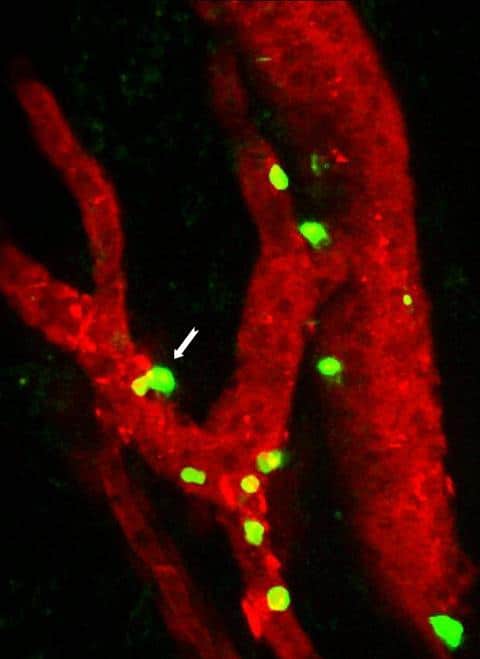
Microscopy visualisation of lymphocytes (in green) squeezing through a tumour HEV vessel (in red) during anti-PD-1 plus anti-CTLA-4 immunotherapy treatment. Note the lymphocyte just to the left of the centre of the video leaving the vessel to enter the tumour (in black). Video: E. BELLARD & J.-P. GIRARD – IPBS (CNRS/UT3 Paul Sabatier) |
More information
- Tumor-associated high endothelial venules mediate lymphocyte entry into tumours and predict response to PD-1 plus CTLA-4 combination immunotherapy – Cancer Cell
Assia Asrir, Claire Tardiveau, Juliette Coudert, Robin Laffont, Lucas Blanchard, Elisabeth Bellard, Krystle Veerman, Sarah Bettini, Fanny Lafouresse, Estefania Vina, Dorian Tarroux, Severine Roy, Isabelle Girault, Irma Molinaro, Frédéric Martins, Jean-Yves Scoazec, Nathalie Ortega, Caroline Robert et Jean-Philippe Girard.- Contact: Elisabeth Bellard or Jean-Philippe Girard