

Within cells, DNA is stored in a compact form. In order to be read and transcribed, its various regions either condense or conversely unfold. By regulating the organisation and function of the genome, the properties of these condensates are at the heart of genome expression.
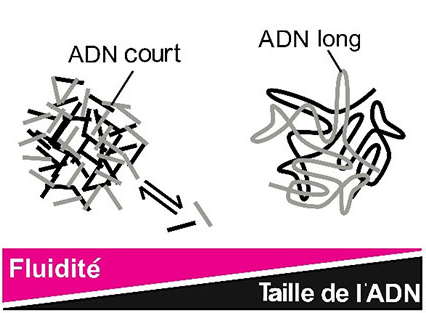
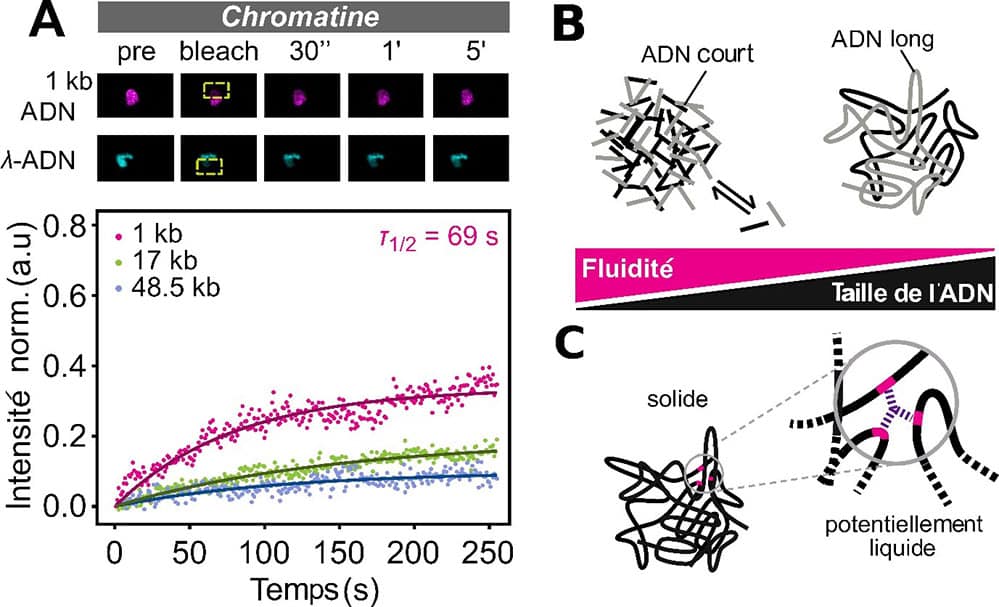 As part of a study published in the journal Biophysical Journal, a group of scientists involving the CBI's TRI-Genotoul platform characterised the condensates according to the size of the DNA molecules constituting them. The results suggest that genomic DNA within the cell could exhibit solid-like behaviour or, conversely, become fluid when the interaction zones involve shorter DNA regions.
While the condensation state of our genome is linked to its degree of expression—with repressed genomic regions thus being more condensed than active regions—researchers detail here the physical modalities of interaction of these DNA strands: their degree of fluidity is inversely proportional to their size. Indeed, if they are short (<1 kb), DNA strands will adopt a liquid-like behaviour, whereas conversely, large ones will operate in a solid-like manner. The insight provided into these behaviours allows, on the one hand, a better understanding of the biases in DNA studies in vitro, using reduced-size strands, and beyond that, to better understand the mechanisms related to the quality of DNA expression.
To find out more
- DNA length tunes the fluidity of DNA-based condensates. Muzzopappa F, Hertzog M, Erdel F. Biophysical Journal 26th February 2021. . https://doi.org/10.1016/j.bpj.2021.02.027
- Researcher contact: Fabian Erdel (CBI +33 5 61 33 58 60
- Read the popular science article on the CNRS website