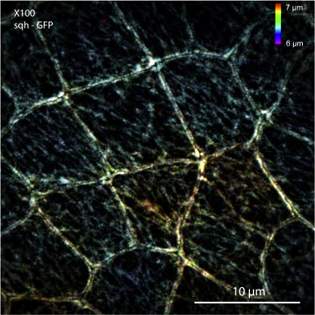


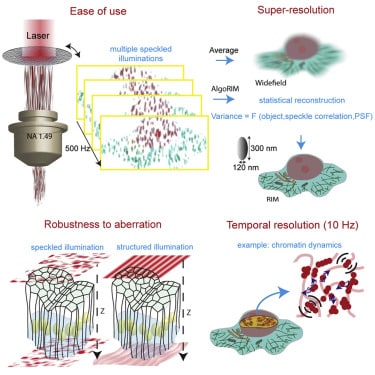
While super-resolution microscopy techniques make it possible to achieve a higher resolution than conventional optics, they remain tricky to implement and sensitive to optical aberrations. A solution, recently published in the journal Cell Reports Methods by a group involving the LITC platform of TRI-Genotoul, proposes a solution via random illumination microscopy.
This new technique presents numerous advantages: the illumination is not affected by optical aberrations induced by the microscope or the sample itself. The implementation of the method on various instruments is consequently greatly simplified. Furthermore, it allows a resolution equivalent to SIM super-resolution imaging (100nm) but with unparalleled optical sectioning, regardless of the observation depth.
Currently being deployed across several sites in France and internationally (IGDR, IBDM, Institut Fresnel, University of Oxford, University of California, University Paris-Saclay), this technology is currently the subject of a 3D RIM research project supported by the ANR and a CNRS INNOVATION pre-maturation project funding continued R&D to improve its exploitation in the life sciences.
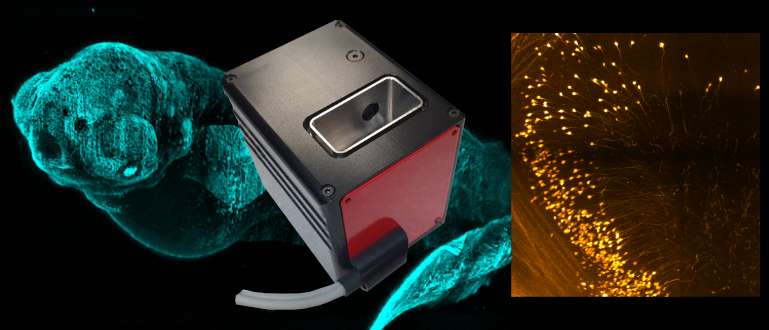
Images : Cell Reports Methods