

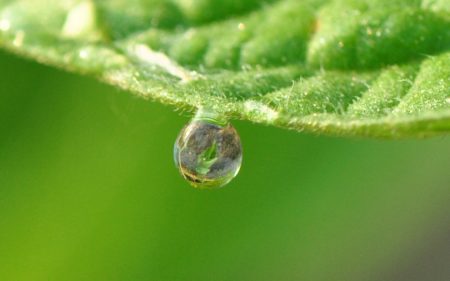
Hydathodes are original structures in more than one respect. Largely described in the literature up until the 1970s*, these organs then fell into oblivion. The team of L. Noël (LIPM) has revived, with the help of the FRAIB imaging platform, the multiple roles played by these very special structures, which are both a safety valve and the Achilles heel of immunity.
During the day, the plants transpire and release water in the form of gas through the stomates, the pores present on the surface of the leaves. However, during the night, the root pressure continues to pump water from the soil to the leaves. While the stomates are closed, with no possibility of drainage, the leaf could die… drowned. This is one of the primary roles of the hydathodes: Their pores, slightly larger than those of the stomates, remain open to evacuate the excess liquid water. Located on the periphery of the leaves, they excrete water drops during the night (this is the guttation phenomenon), a phenomenon not to be confused with dew. (see photo).
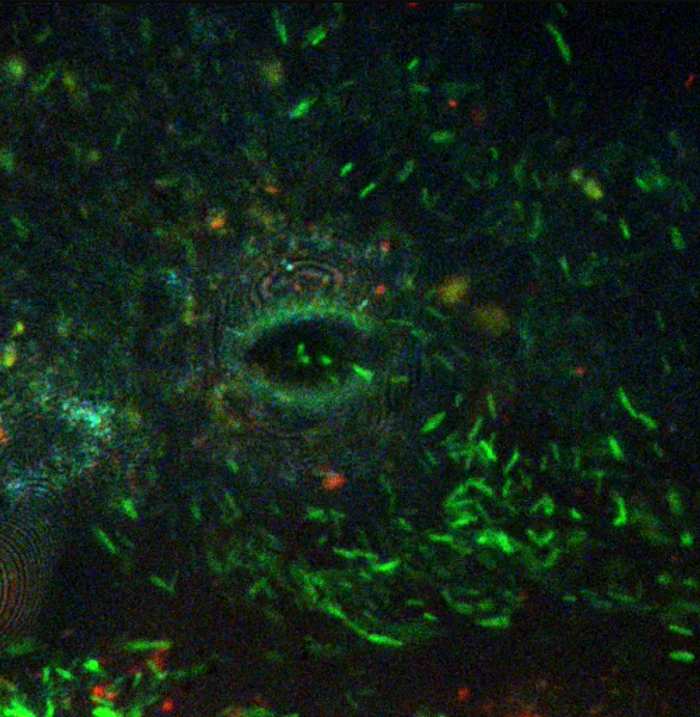
Even more surprising, the superposition of hydatodes and infection sites from several diseases (black necrosis, cancers, etc.) indicates to the researchers that these pores are also entry points for pathogens. With the FRAIB imaging platform (specialized in imaging of plants), our researchers were able to film in confocal microscopy a hydatode pore «sucking» pathogenic bacteria.
Contact: Laurent Noël / Alain Jauneau
Publication references : Mangroves in the Leaves: Anatomy, Physiology, and Immunity of Epithemal Hydathodes – Annual Review of Phytopathology. Vol. 57 (08/19). Aude Cerutti, Alain Jauneau, Patrick Laufs, Nathalie Leonhardt, Martin Schattat, Richard Berthomé, Jean-Marc Routaboul, & Laurent D. Noël
*Perrin A. 1972. Contribution to the study of the organization and functioning of hydatid worms: ultrastructural and physiological anatomical research. PhD Thesis, Univ. Lyon, France